
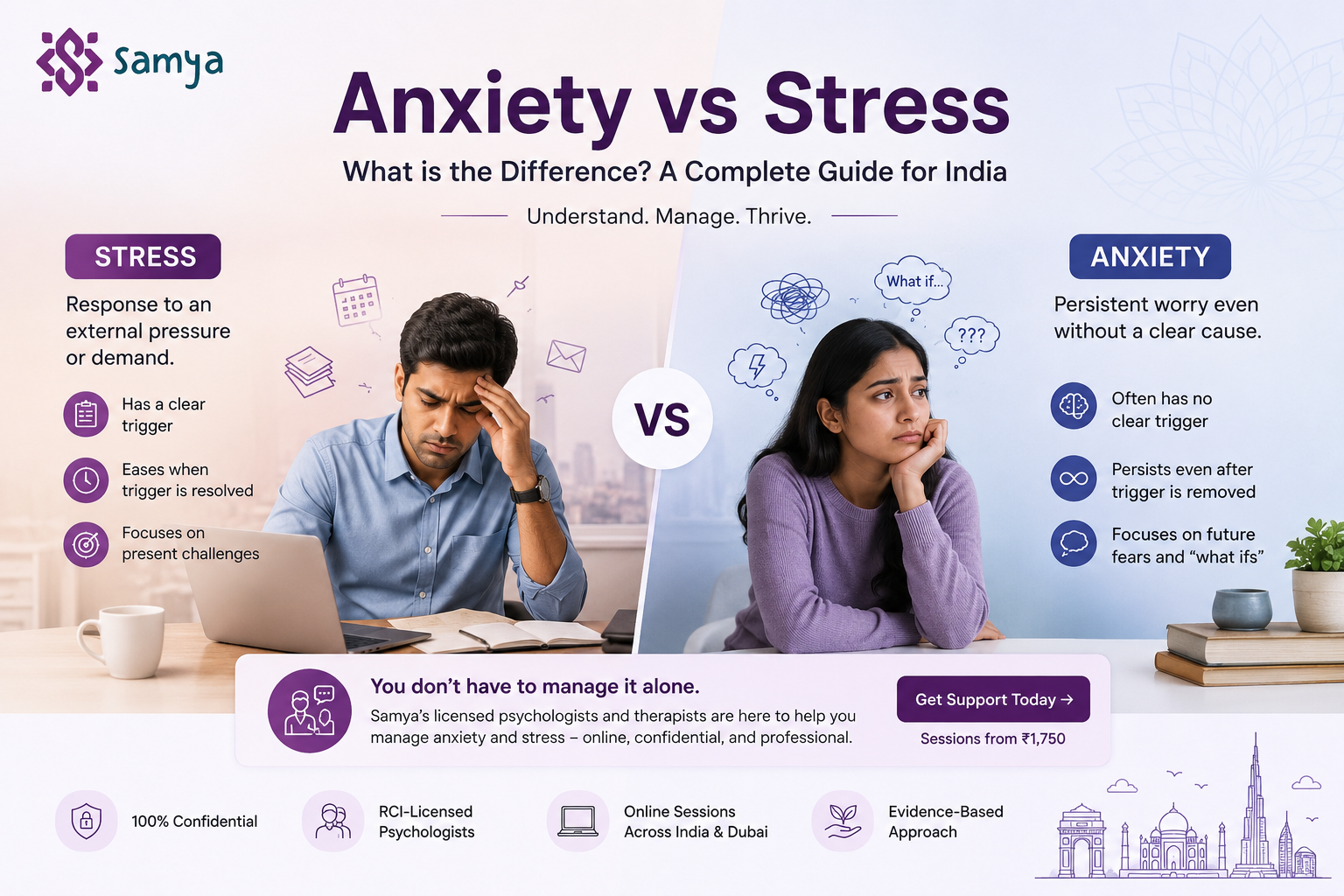
"I am so stressed" and "I have anxiety" , these phrases are often used interchangeably in everyday conversation. But stress and anxiety are not the same thing. Understanding the difference could be the first step toward getting the right help.
Both stress and anxiety are common experiences especially in India, where workplace pressure, family expectations, financial concerns, and social demands create a uniquely complex emotional landscape. But while they share some symptoms, they have different causes, different patterns, and importantly, different solutions.
In this guide, we break down exactly what stress and anxiety are, how to tell them apart, and what to do when either becomes overwhelming.
What is Stress?
Stress is a natural response to an external pressure or demand. It is your mind and body reacting to a specific challenge a deadline at work, a difficult conversation, financial pressure, or a major life change.
Stress is typically tied to an identifiable cause. When the cause is removed or resolved, the stress usually eases. It is the body's way of mobilising energy to deal with a challenge the classic "fight or flight" response.
Common causes of stress in India:
- Work deadlines, performance pressure, and job insecurity
- Financial concerns and debt
- Family expectations and relationship conflicts
- Health issues your own or a loved one's
- Major life transitions marriage, relocation, new job
What is Anxiety?
Anxiety is different. While stress has a clear external trigger, anxiety often persists even when there is no identifiable threat. It is characterised by excessive, persistent worry that is difficult to control worry that continues even after the stressful situation has passed, or that appears without an obvious cause.
Anxiety involves a future-focused fear a sense that something bad is going to happen, even when there is no clear evidence for it. Over time, it can interfere significantly with daily life, relationships, work, and physical health.
Common signs of anxiety:
- Persistent worry that is hard to switch off
- Racing thoughts, especially at night
- Physical symptoms racing heart, tight chest, shortness of breath, dizziness
- Avoiding situations because of fear
- Difficulty concentrating
- Feeling restless, on edge, or unable to relax
- Sleep disturbances
Stress vs Anxiety Key Differences
| Factor | Stress | Anxiety |
|---|---|---|
| Trigger | Identifiable external cause | Often no clear cause, or disproportionate to trigger |
| Duration | Eases when trigger is resolved | Persists even after trigger is removed |
| Focus | Present challenge | Future-focused fear and "what ifs" |
| Control | Easier to manage once trigger is addressed | Difficult to control even with logic |
| Physical symptoms | Tension, fatigue, irritability | Racing heart, chest tightness, dizziness, panic |
| Impact on daily life | Temporary disruption | Can significantly impair functioning |
| Treatment | Stress management, lifestyle changes | Therapy (CBT), professional support |
Key insight: Stress says "I have too much to deal with right now." Anxiety says "Something is wrong, even though I cannot always explain what." If your worry persists long after the stressful situation has resolved, or appears without a clear trigger, it may be anxiety rather than stress.
Can Stress Lead to Anxiety?
Yes. Prolonged, unmanaged stress can develop into anxiety over time. When the body remains in a state of high alert for extended periods due to chronic work pressure, relationship difficulties, or financial strain it can begin to trigger the anxiety response even in the absence of an immediate threat.
This is particularly relevant in India, where workplace culture often normalises overwork, and where seeking mental health support is still sometimes stigmatised. Many people push through stress for months or years before recognising that it has developed into something more persistent.
Stress and Anxiety in the Indian Context
In India, both stress and anxiety are significantly underreported not because they are less common, but because of the stigma associated with acknowledging mental health challenges.
According to the National Mental Health Survey of India, approximately 14% of Indians require active mental health interventions yet the treatment gap remains enormous. Millions of people manage stress and anxiety without any professional support, often turning to family, religious practices, or simply pushing through.
While these coping strategies have value, they are not always sufficient particularly when anxiety has become chronic and is affecting work, relationships, and quality of life.
How to Manage Stress
- Identify the source what specific pressures are creating stress?
- Set boundaries at work and in relationships
- Physical activity even a 20-minute walk significantly reduces cortisol
- Sleep hygiene consistent sleep and wake times
- Talk to someone a trusted friend, family member, or therapist
- Reduce caffeine and alcohol both amplify the stress response
How to Manage Anxiety
- Cognitive Behavioural Therapy (CBT) the most evidence-based treatment for anxiety
- Breathing techniques slow, diaphragmatic breathing activates the parasympathetic nervous system
- Mindfulness grounding techniques help interrupt the anxiety cycle
- Limit avoidance gradually facing feared situations reduces anxiety over time
- Professional support a licensed therapist can provide personalised, evidence-based treatment
When to seek professional help: If anxiety or stress is significantly affecting your sleep, relationships, work performance, or daily functioning for more than two weeks, please speak to a mental health professional. Early intervention leads to faster and more complete recovery.
Struggling with anxiety or stress?
Samya's RCI-licensed psychologists and certified therapists specialise in anxiety and stress management online, confidential, and available across India and Dubai. Sessions from ₹1,750.
Frequently Asked Questions
What is the main difference between anxiety and stress?
Stress is typically caused by an identifiable external pressure and eases when that pressure is resolved. Anxiety persists even without a clear trigger, involves excessive future-focused worry, and is harder to control through logic or willpower alone.
Can stress cause anxiety?
Yes. Prolonged, unmanaged stress can trigger the anxiety response even in the absence of an immediate threat. Chronic stress is one of the most common contributing factors to the development of anxiety disorders.
What are the physical symptoms of anxiety?
Common physical symptoms of anxiety include a racing or pounding heart, tightness in the chest, shortness of breath, dizziness, sweating, trembling, and nausea. These symptoms occur because anxiety activates the body's fight-or-flight response.
Is anxiety common in India?
Yes. According to the National Mental Health Survey of India, anxiety disorders are among the most common mental health conditions in the country. However, many people go undiagnosed and untreated due to stigma and limited access to mental health services.
What is the best treatment for anxiety?
Cognitive Behavioural Therapy (CBT) is the most well-researched and effective treatment for anxiety. It helps individuals identify and change the thought patterns and behaviours that maintain anxiety. Online therapy makes CBT accessible across India without the need to visit a clinic.
How do I know if I have anxiety or just stress?
Ask yourself: Does the worry ease when the stressful situation resolves? If yes, it is likely stress. If the worry persists, appears without a clear cause, or feels impossible to control despite your best efforts it may be anxiety. Speaking to a licensed therapist can help you understand what you are experiencing and how to address it.
Mohd Sadiq
Mental Health Content Writer at Samya. Works closely with licensed therapists and coaches to create evidence-based, accessible mental health resources for individuals and organisations across India and Dubai.
This article has been reviewed by Neha Niharika, Licensed Clinical Psychologist at Samya (BA, MA, MPhil | RCI License in Clinical Psychology | 10+ years experience). Last updated: May 2026.