
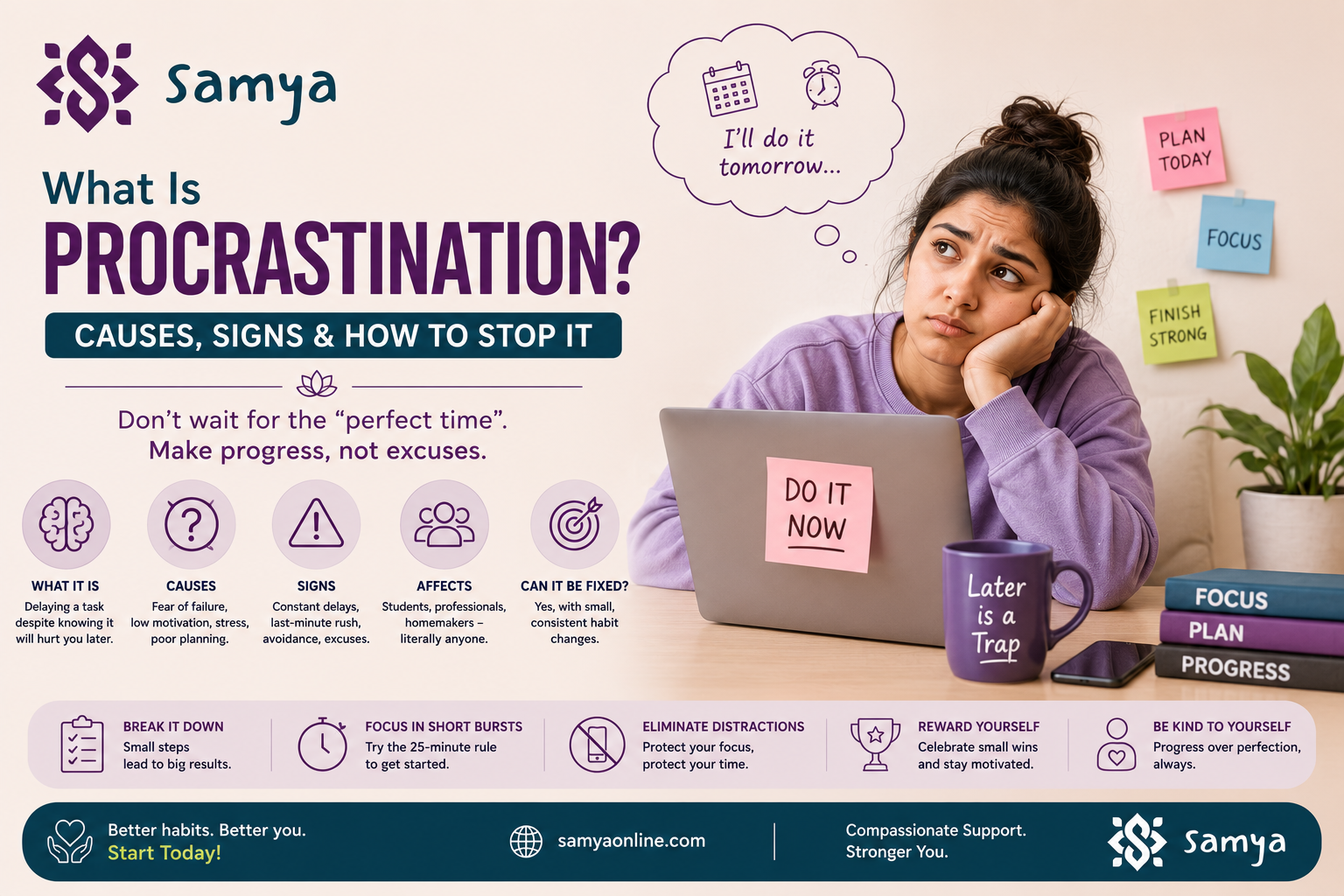
You had the whole day. You still haven't opened that file. Sound familiar? That's procrastination doing what it does best quietly stealing your time while whispering "you've got this, just five more minutes." Almost everyone deals with procrastination at some point, and honestly, there's no shame in it. The real question is why it happens and what you can actually do about it.
|
Aspect |
Quick Snapshot |
|
What it is |
Delaying a task despite knowing it will hurt you later |
|
Common causes |
Fear of failure, low motivation, stress, poor planning |
|
Common signs |
Constant delays, last-minute rush, avoidance, excuses |
|
Who it affects |
Students, professionals, homemakers literally anyone |
|
Can it be fixed |
Yes, with small consistent habit changes |
Procrastination Meaning: Let's Break It Down Simply
In plain words, procrastination means putting off something important even when you know it's going to bite you later. It's not laziness that's a common myth. Laziness is not wanting to do anything at all. Procrastination is different. You want to do the task, you know it matters, and yet somehow you end up scrolling your phone or reorganising your desk instead.
The word itself comes from Latin, but forget the textbook definition for a second. Think about the last time you delayed replying to an important email or pushed your workout to "tomorrow" for the tenth day in a row. That's procrastination in its most everyday, relatable form. It sneaks into study schedules, office deadlines, health goals, even relationships where a tough conversation keeps getting postponed.
Why Do People Procrastinate? The Real Reasons Behind It
This is where things get interesting. Most people assume procrastination is just poor time management, but psychologists say it's much more emotional than logical. People procrastinate because the brain is wired to avoid discomfort, and a difficult or boring task feels uncomfortable right now, while the consequences feel far away and vague.
Fear plays a huge role too. Fear of failing, fear of not being good enough, or even fear of succeeding and having to keep up that standard later. When a task feels overwhelming, the brain looks for an escape route, and Netflix or Instagram happily offers one.
Perfectionism is another sneaky cause of procrastination. Ironically, people who want to do something perfectly often delay starting because they're scared the result won't match the picture in their head. There's also plain old low motivation when a task doesn't feel meaningful or rewarding; the mind keeps finding reasons to avoid it. Add poor planning, unclear goals, or simple exhaustion into the mix, and you have the perfect recipe for chronic procrastination.
Signs of Procrastination You Might Be Ignoring
Some signs of procrastination are obvious; others are so normal to us that we don't even notice them anymore. Waiting until the deadline is a few hours away before starting is the classic one. Constantly telling yourself "I'll start after this one episode" is another red flag.
Making a long to-do list but somehow completing only the easiest, least important items is a subtle sign of procrastination too. So is spending more time planning how you'll do a task than actually doing it. If you notice yourself feeling guilty about a pending task but still avoiding it, that guilt-avoidance cycle is a strong indicator. Physical restlessness, irritability when reminded of the task, or blaming lack of time when the real issue is lack of will all of these point to procrastination quietly running the show.
How To Stop Procrastination Without Overhauling Your Whole Life
Here's the good news: you don't need a dramatic personality change to fix this. Small, consistent shifts work far better than big resolutions that fizzle out in a week.
Start with the two-minute rule. If a task takes less than two minutes, do it immediately instead of adding it to a list. For bigger tasks, break them into smaller, less intimidating chunks. Writing "finish project" on your list feels heavy, but writing "open the document and write one paragraph" feels doable, and doable is what gets started.
Removing distractions helps more than people realise. Keep your phone in another room, or use an app blocker during focused hours. Setting a timer for just twenty-five minutes of focused work, followed by a short break, tricks the brain into starting without the pressure of finishing everything at once.
It also helps to understand your own procrastination pattern. Are you avoiding a task because it's boring, or because you're scared of doing it wrong? Naming the actual reason takes away a lot of its power. Rewarding yourself after completing a task, even something small like a cup of chai or five minutes of your favourite song, builds a positive loop that makes the next task easier to begin.
Causes of Procrastination Rooted in Mindset, Not Just Habit
While habits matter, a lot of procrastination is rooted in mindset. People with low self-confidence often procrastinate because they doubt their own ability to complete a task well, so avoiding it feels safer than facing possible failure. On the other end, people who are used to working under pressure convince themselves that stress actually helps them perform better, so they keep waiting for that adrenaline to kick in.
Environmental causes matter too. A cluttered workspace, constant notifications, or an unclear goal can quietly fuel procrastination without you even realising it's happening. Understanding these root causes is the real first step toward lasting change, not just another to-do list app.
Overcome Procrastination For Good: A Realistic Approach
To truly overcome procrastination, consistency beats intensity every single time. Instead of trying to fix everything overnight, focus on one task a day that you've been avoiding, and just start it, even imperfectly. Progress, not perfection, is what breaks the cycle of procrastination.
Accountability also works wonders. Telling a friend or colleague about your goal, or working alongside someone else, adds a gentle social pressure that keeps you moving. Tracking small wins, even on paper, gives your brain visible proof that you're capable of finishing things, which slowly rewires the avoidance pattern.
If procrastination is affecting your studies, work, or mental peace regularly, reading structured guides on productivity and mental wellbeing from trusted platforms like Psychology Today can offer additional science-backed strategies worth exploring alongside your own efforts.
Frequently Asked Questions
Is procrastination a mental health issue?
Not always. Occasional procrastination is completely normal, but chronic procrastination linked with anxiety or depression may need professional support.
What is the root cause of procrastination?
Most often it's an emotional response to discomfort, fear, or overwhelm rather than simple laziness or bad time management.
Can procrastination be completely cured?
It can be managed very effectively with the right habits, self-awareness, and consistent small actions, even if it never disappears completely.
Does procrastination affect productivity at work?
Yes, it's one of the biggest silent productivity killers, leading to rushed work, missed deadlines, and unnecessary stress.
What's a simple daily habit to stop procrastination?
Start your day by completing the one task you're most likely to avoid, before checking your phone or emails.
Final Thoughts
Procrastination isn't a character flaw, it's a pattern, and patterns can be changed with patience and the right approach. Once you understand why you procrastinate, spotting the signs early becomes much easier, and stopping procrastination stops feeling like an uphill battle. If you're looking for more practical, no-jargon guidance on building better habits and beating procrastination for good, head over to samyaonline.com and explore resources designed to help you take action, one small step at a time brought to you by Samya.