
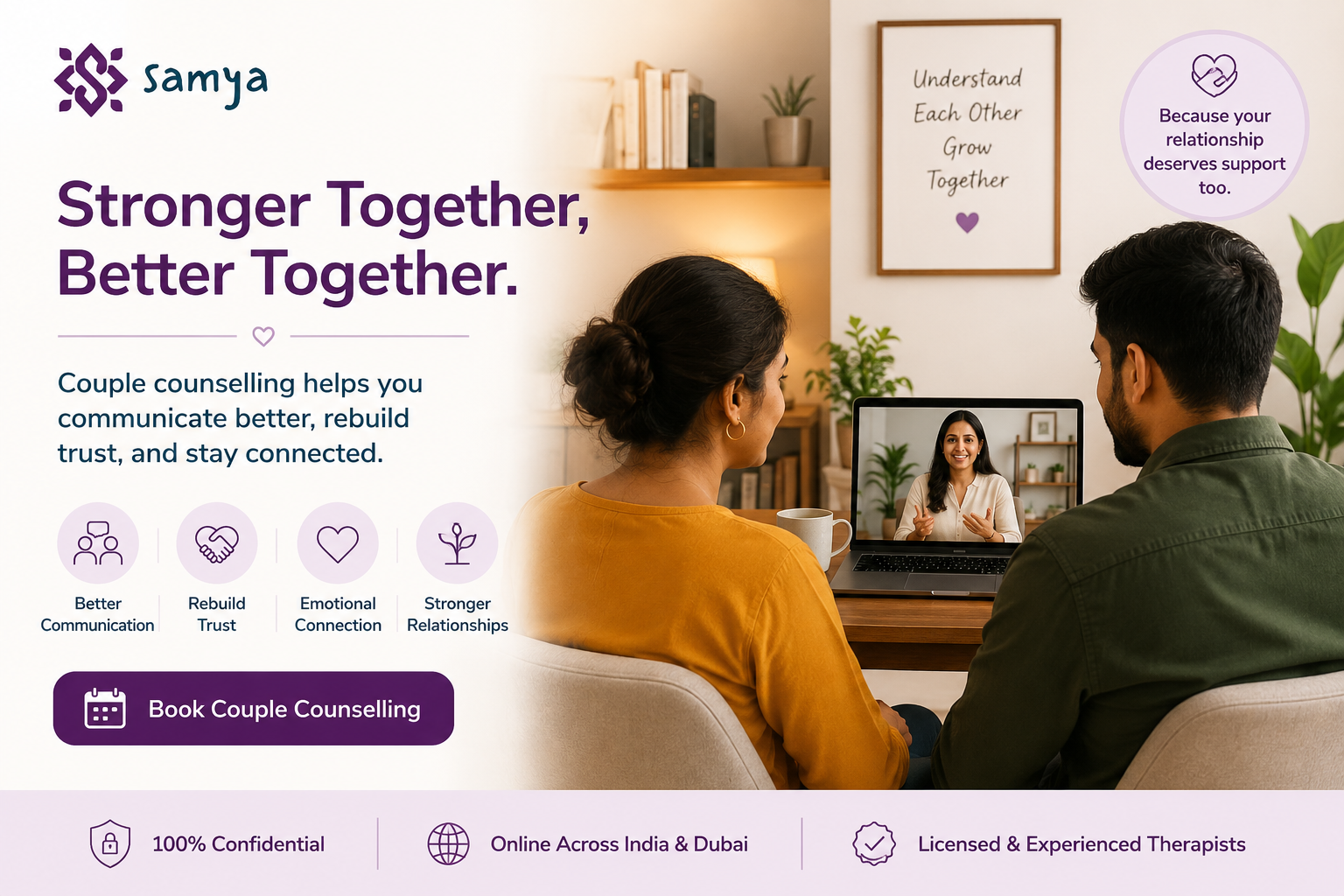
Love brings two people together. But love alone does not teach you how to communicate without hurting each other, how to rebuild trust after it has been broken, or how to stay connected when life pulls you in different directions. That is what therapy is for.
Something is shifting in India. Quietly, steadily, and meaningfully. Couples, young and not so young, urban and increasingly beyond metros, are choosing to speak to a therapist together. Not because their relationship is over, but because they want it to last.
This is a profound change in a country where relationships have long been expected to work themselves out, where asking for help was seen as weakness, and where the idea of discussing your marriage with a stranger felt deeply uncomfortable.
So what has changed? And what does couples counselling actually offer that love alone cannot?
The Myth That Love Is Enough
We grow up in India surrounded by a particular idea of love intense, sacrificial, and enduring. Bollywood tells us that love conquers all. Family elders tell us that adjustment is the key. Religion tells us that commitment is sacred.
None of this is wrong. But none of it teaches couples how to argue without contempt, how to listen without defending, how to repair after a rupture, or how to navigate the enormous pressures that modern Indian life places on a relationship.
Consider what a typical urban Indian couple faces today:
- Dual careers, financial pressure, and competing ambitions
- Family expectations from both sides about everything from children to finances to where you live
- The invisible load of domestic labour, disproportionately carried by women
- Long working hours, commutes, and digital fatigue that leave little emotional energy for each other
- Social media comparisons that create unrealistic expectations of what a relationship should look like
- Changing gender roles that both partners are still negotiating
Love is present in most of these relationships. But love without the skills to navigate these pressures is like a boat without oars you may care deeply about reaching the other shore, but caring is not enough to get there.
Why Indian Couples Are Turning to Therapy
The decision to seek couple counselling in India is rarely impulsive. Most couples come to therapy after months sometimes years of unresolved conflict, emotional distance, or quiet despair. They come because something has reached a breaking point, or because one or both partners has recognised that things cannot continue as they are.
But increasingly, couples are also coming earlier not in crisis, but in prevention. They come because they want to communicate better. After all, they are preparing for a major life transition, or simply because they want to invest in the relationship they value most.
A shift in mindset: For the previous generation, seeking outside help for a relationship was often seen as airing dirty laundry or admitting failure. For many younger Indians today, it is increasingly seen as an act of commitment to choose to fight for the relationship rather than letting it deteriorate in silence.
What Couple Counselling Actually Does
Couple counselling is not about a therapist telling you who is right and who is wrong. It is not about rehashing every grievance from the past five years. And it is not about keeping the relationship together at all costs.
What it actually does is far more useful.
1. It creates a safe space for difficult conversations
Many couples avoid the most important conversations because they fear what will happen if they have them the fight that never ends, the revelation that cannot be taken back. A therapist creates a structure where these conversations can happen safely, with support, and with someone to help navigate when things get heated.
2. It helps you understand each other's patterns
Most relationship conflicts are not really about the dishes, the money, or the in-laws. They are about underlying needs for security, for respect, for autonomy, for connection that are not being met. Therapy helps couples see what is actually happening beneath the surface of their arguments.
3. It teaches practical communication skills
Research by Dr John Gottman, one of the world's leading relationship researchers shows that it is not the presence of conflict that predicts relationship breakdown, but how couples handle conflict. Therapy teaches specific, learnable skills: how to raise concerns without criticism, how to listen without becoming defensive, how to repair after a rupture.
4. It rebuilds trust after betrayal
Whether the betrayal is infidelity, financial dishonesty, or a pattern of emotional unavailability, trust can be rebuilt, but it requires a structured, honest process. Therapy provides that structure.
5. It helps couples make clear-headed decisions
Sometimes couple counselling leads to a stronger, more connected relationship. Sometimes it helps two people recognise, with clarity and compassion, that they are better apart. Either outcome, arrived at honestly, is more valuable than years of unresolved suffering.
Common Reasons Indian Couples Seek Therapy
| Reason | What It Often Looks Like |
|---|---|
| Communication breakdown | Every conversation becomes an argument; feeling unheard or dismissed |
| Emotional distance | Living like roommates; loss of intimacy and connection |
| Infidelity or trust issues | Betrayal physical or emotional and the aftermath |
| Family interference | In-laws, joint family dynamics, conflicting loyalties |
| Parenting disagreements | Different approaches to raising children create conflict |
| Financial stress | Disagreements about money, debt, spending, or financial goals |
| Major life transitions | Relocation, career change, illness, loss and the strain they create |
| Pre-marital preparation | Understanding each other before marriage increasingly common |
Is Couple Counselling Only for Marriages in Crisis?
No and this is perhaps the most important misconception to address.
The couples who benefit most from therapy are often not the ones in the deepest crisis. They are the couples who come early enough that patterns have not yet calcified, that hurt has not yet hardened into resentment, and that both partners are still genuinely invested in making things work.
Pre-marital counselling sessions before marriage to build communication skills and align on expectations are also growing in India. It is one of the most pragmatic investments a couple can make.
"We did not wait until things were broken. We started therapy six months into our marriage, when we noticed we kept having the same argument over and over. After eight sessions, we understood each other in a way we never had before, and we had tools we actually use."
What About the Stigma?
It exists. Particularly in smaller cities, and particularly among older generations, the idea of discussing your relationship with a therapist still carries judgment. "What will people think?" remains a real concern for many Indian couples.
Online couple counselling has changed this significantly. When sessions happen via audio or video call, from the privacy of your own home, the stigma barrier drops considerably. No one sees you walking into a therapist's office. No one knows you are in therapy unless you choose to tell them.
At Samya, all couples' counselling sessions are fully confidential and conducted online, making professional support accessible to couples across India and Dubai, regardless of where they live or what others might think.
Ready to invest in your relationship?
Samya's licensed therapists specialise in couple counselling online, confidential, and available across India and Dubai. Book a session and start the conversation that matters most.
Frequently Asked Questions
What is couples counselling and how does it work?
Couple counselling is a form of therapy where both partners meet with a licensed therapist, together or sometimes individually, to address relationship challenges. The therapist helps the couple understand their patterns, improve communication, and work through specific issues in a structured, safe environment.
Is couples counselling only for marriages that are failing?
No. Couple counselling is beneficial at any stage of a relationship, whether you are navigating a specific challenge, experiencing recurring conflict, feeling emotionally distant, or simply wanting to build a stronger foundation. Many couples seek therapy proactively, before things reach a crisis point.
How long does couples counselling take?
This varies depending on the nature of the challenges and the goals of the couple. Some couples see significant improvement in 6 to 8 sessions. Others benefit from longer-term support. Your therapist will discuss a recommended approach after the first session.
Can couples counselling save a marriage?
Couples counselling gives relationships the best possible chance by building communication skills, rebuilding trust, and creating a space for honest conversation. Research shows it is effective for the majority of couples who engage seriously with the process. However, both partners need to be willing to participate.
Is online couple counselling as effective as in-person?
Yes. Research consistently shows that online therapy, including couples counselling, produces outcomes comparable to those of in-person therapy. Online sessions also offer greater privacy and flexibility, which can make it easier for both partners to commit consistently.
How much does couple counselling cost in India?
At Samya, couples counselling sessions are available online with licensed therapists across India and Dubai. Session fees vary by therapist you can view individual pricing on each therapist's profile before booking.
Mohd Sadiq
Mental Health Content Writer at Samya. Works closely with licensed therapists and coaches to create evidence-based, accessible mental health resources for individuals and organisations across India and Dubai.
This article has been reviewed by Neha Niharika, Licensed Clinical Psychologist at Samya (BA, MA, MPhil | RCI License in Clinical Psychology | 10+ years experience). Last updated: May 2026.