
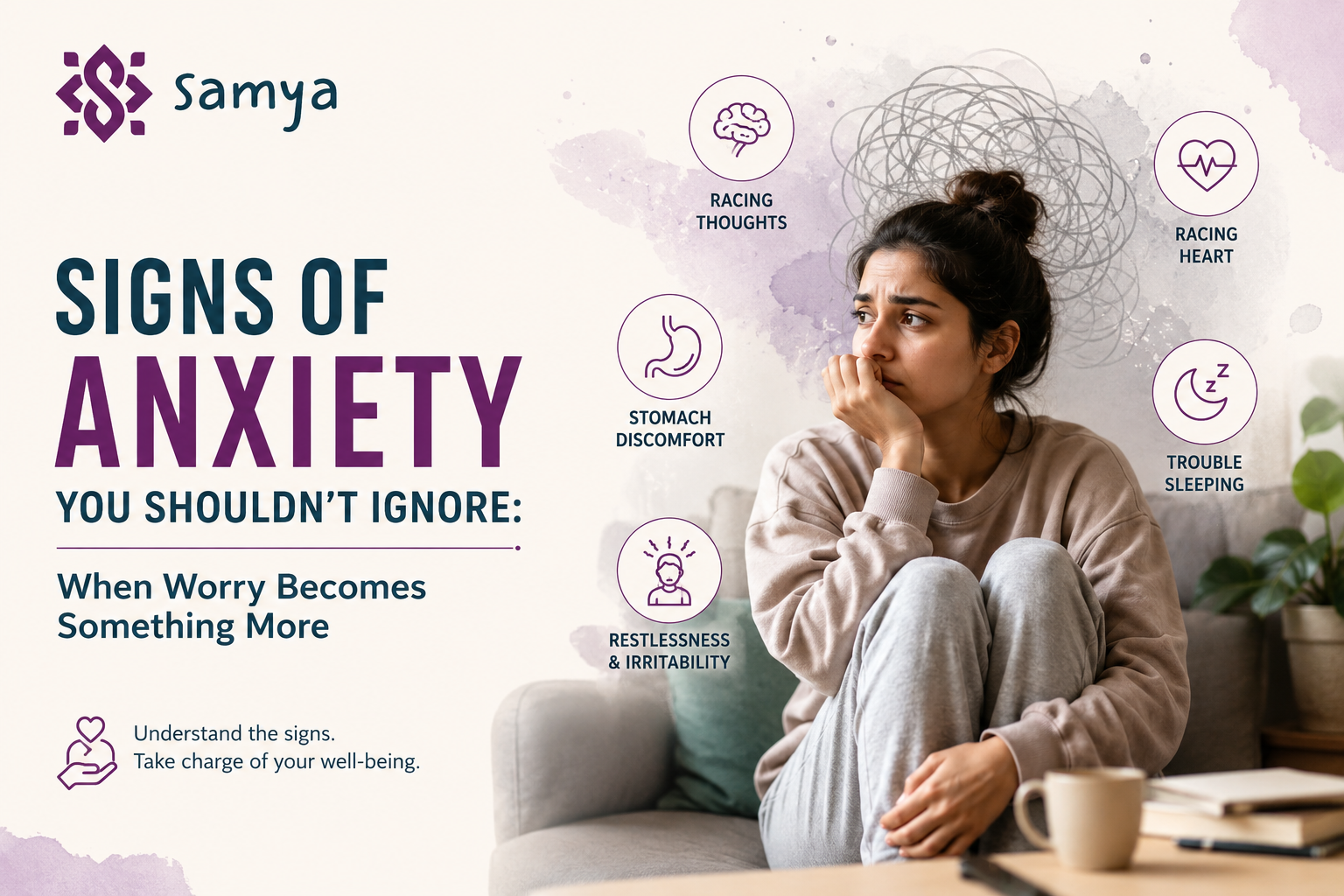
We've all had those nights where the mind just won't switch off. A big presentation the next day, an awkward conversation replaying on loop, or simply that nagging feeling that something's wrong even when nothing actually is. Most of the time, it passes. But for a growing number of people, that restless, on-edge feeling doesn't go away; it just becomes the background noise of everyday life. That's usually when doctors start talking about the signs of anxiety, and why catching them early actually matters more than people realise.
Anxiety isn't just "overthinking" or being a worrier by nature. It's a real, measurable shift in how your brain and body respond to stress, and left unchecked, it can quietly take over your sleep, your relationships, your work, and your sense of self. Here's a quick snapshot before we dig deeper.
|
Category |
Common Signs |
Often Mistaken For |
|
Physical |
Racing heart, sweaty palms, tight chest |
Heart trouble or fatigue |
|
Emotional |
Constant dread, irritability, restlessness |
Stress or a bad mood |
|
Cognitive |
Racing thoughts, trouble concentrating |
Laziness or distraction |
|
Behavioural |
Avoiding people or places, procrastination |
Introversion or disinterest |
|
Sleep-related |
Trouble falling or staying asleep |
Insomnia unrelated to mood |
Why We Keep Missing The Early Signs Of Anxiety
Here's the tricky part. Anxiety rarely shows up wearing a name tag. It disguises itself as tiredness, as "just a stressful week," as a stomach bug that won't quit, or as being "a bit of a control freak" at work. The signs of anxiety are often physical before they're emotional, which is exactly why so many people end up at a cardiologist's clinic with a racing heart, only to be told their heart is perfectly fine.
Doctors say this delay in recognising anxiety is one of the biggest reasons it goes untreated for years. People push through, tell themselves they're just "wired that way," and carry on until the body starts sending louder signals.
The Physical Signs Of Anxiety Nobody Talks About Enough
A pounding heartbeat for no clear reason. A tight, almost breathless feeling in the chest. Sweaty palms in an air-conditioned room. Stomach knots before something as ordinary as a phone call. These aren't random. They're the body's alarm system going off when it senses a threat, even if that "threat" is just an email from your boss.
Some people also notice muscle tension that never really eases, jaw clenching, tension headaches, or a strange fatigue that sleep doesn't fix. If several of these show up together and stick around for weeks rather than days, it's worth paying attention rather than brushing it off as "just stress."
The Emotional And Mental Signs Of Anxiety
Beyond the physical, anxiety often shows up as a persistent sense of dread that has no obvious source. You might feel like something bad is about to happen, even when everything in your life is, on paper, going fine. Irritability creeps in. Small things start to feel unbearably big. Concentration becomes a struggle, and decisions that used to take two minutes now feel impossible.
There's also the racing-thoughts pattern, where the brain jumps from one worry to the next without ever landing anywhere useful. This mental restlessness is exhausting, and it's one of the clearest signs of anxiety that people tend to dismiss as "just being a busy thinker."
When Anxiety Becomes A Phobia: Understanding Anxiety Phobia
There's a difference between everyday anxiety and what experts call anxiety phobia, an intense, often irrational fear tied to a specific object, situation, or activity. Think of someone who avoids flying at all costs, or someone whose heart races just at the thought of speaking in public. This isn't shyness or caution, it's a nervous system that has learned to treat a specific trigger as genuinely dangerous.
A phobic anxiety disorder goes a step further. It's a diagnosable condition where the fear response is so strong that it disrupts daily functioning, work, relationships, even simple errands. Someone with a phobic anxiety disorder might rearrange their entire life around avoiding lifts, crowded spaces, or social gatherings. The distressing part is that most people with this condition know their fear is disproportionate, but knowing that doesn't make it go away. That's the nature of phobic anxiety disorder, it lives in the nervous system, not in logic.
Could It Be More Than Stress? Taking An Anxiety Test
If you've been nodding along to most of what's written above, it might be worth taking a proper anxiety test rather than guessing. A good anxiety test, like the GAD-7 screening tool used widely by clinicians, asks simple questions about how often you've felt nervous, unable to control worrying, restless, or on edge over the past two weeks. It's not a diagnosis on its own, but it gives a useful starting point.
An anxiety test isn't about labelling yourself. It's about having a clearer, less emotional picture of what's actually going on, so you and a professional can decide what kind of support makes sense. Platforms like Samya have made this easier by offering accessible, confidential screening tools so people don't have to walk into a clinic blind, unsure of what they're even dealing with.
Breathing Exercises For Anxiety That Actually Work
Now for the part that people usually want to skip straight to. Breathing exercises for anxiety are one of the simplest, most evidence-backed tools available, and they work because they directly influence the nervous system.
The 4-7-8 technique is a good place to start. Breathe in through the nose for four counts, hold for seven, and exhale slowly through the mouth for eight. Repeat this four or five times. It sounds almost too simple, but it activates the body's relaxation response and can noticeably slow a racing heart within minutes.
Box breathing is another one worth learning: inhale for four counts, hold for four, exhale for four, hold again for four, and repeat. Athletes and even military personnel use this to stay calm under pressure, which says a lot about how effective it can be for ordinary daily anxiety too.
The point of breathing exercises for anxiety isn't to eliminate anxious feelings in one go. It's to interrupt the spiral before it builds, giving your mind a chance to catch up with your body.
Is Anxiety Treatable? Here's What The Evidence Says
This is probably the most important question in this entire article, and the honest answer is yes, anxiety is treatable. It's one of the most well-researched and well-understood mental health conditions, and treatment success rates are genuinely encouraging when people get the right support.
Cognitive behavioural therapy, or CBT, remains the gold standard. It helps people identify and reshape the thought patterns that fuel anxious spirals. For some, medication prescribed by a psychiatrist helps regulate the underlying chemistry while therapy does the deeper work. Lifestyle changes, better sleep, regular movement, cutting back on caffeine, and consistent breathing exercises for anxiety all add up too. So if you've been wondering, is anxiety treatable, the research is fairly clear, with the right approach, most people see real, lasting improvement.
Is Anxiety Disorder Curable, Or Is It Managed For Life?
This question comes up a lot, and it deserves an honest answer rather than a comforting one. Is anxiety disorder curable in the sense of being permanently erased? Not always, but that's not quite the right way to think about it either. For many people, anxiety disorder is highly manageable, to the point where symptoms become mild, occasional, or barely noticeable in daily life.
Some people go through a course of therapy and rarely experience significant anxiety again. Others manage it more like a chronic condition, something that needs occasional check-ins, similar to how someone might manage blood pressure. Either way, is anxiety disorder curable becomes a less important question than is anxiety disorder manageable, and for the vast majority of people, the answer to that is a confident yes.
When To Actually See Someone About It
If the signs of anxiety have been sticking around for more than two weeks, if they're affecting your sleep, your work, or your relationships, or if you've started avoiding everyday situations because of fear, it's time to talk to someone qualified. There's no prize for pushing through alone, and early support almost always makes recovery faster and easier.
This is where platforms like Samya step in, connecting people with licensed therapists and psychiatrists without the usual friction of long waitlists or awkward first-time appointments. If any part of this article felt a little too familiar, please book a consultation through Samya rather than sitting with the discomfort a little longer. You can start that conversation anytime at samyaonline.com.
For broader, research-backed information on anxiety disorders, the World Health Organization's mental health page is a solid, trustworthy resource worth bookmarking.
Frequently Asked Questions
What are the earliest signs of anxiety people usually miss?
Physical symptoms like a racing heart, tight chest, or stomach trouble tend to show up befor the emotional signs, which is why so many people mistake early anxiety for a physical illness.
Are breathing exercises for anxiety enough on their own?
They help a lot in the moment and are great for daily management. Still, for ongoing or severe anxiety, breathing exercises for anxiety work best alongside therapy or professional guidance, not as a standalone fix.
Is an anxiety test accurate enough to rely on?
An anxiety test like the GAD-7 is a solid screening tool used by professionals worldwide, but it's meant to guide the next step, not replace a proper conversation with a therapist or doctor.
What's the difference between general anxiety and anxiety phobia?
General anxiety tends to be broader and less specific, while anxiety phobia is tied to a particular trigger, like heights, flying, or crowds, with a much more intense fear response.
Is anxiety treatable even in severe cases?
Yes, even severe anxiety responds well to treatment, especially when therapy and, where needed, medication are combined with lifestyle changes.
Is anxiety disorder curable, or will it come back?
It varies from person to person. Many people see their symptoms fade almost entirely, while others manage it long-term with occasional support, similar to any other chronic condition.
Where can I get help if I recognise these signs of anxiety in myself?
You can take a screening step, speak with a licensed professional, or book a consultation through samyaonline.com to figure out the right next move for your situation.